Proof layer
Find out whether a real buyer will actually act
Buyer Proof is the first layer where the market, rather than the company, produces the evidence.
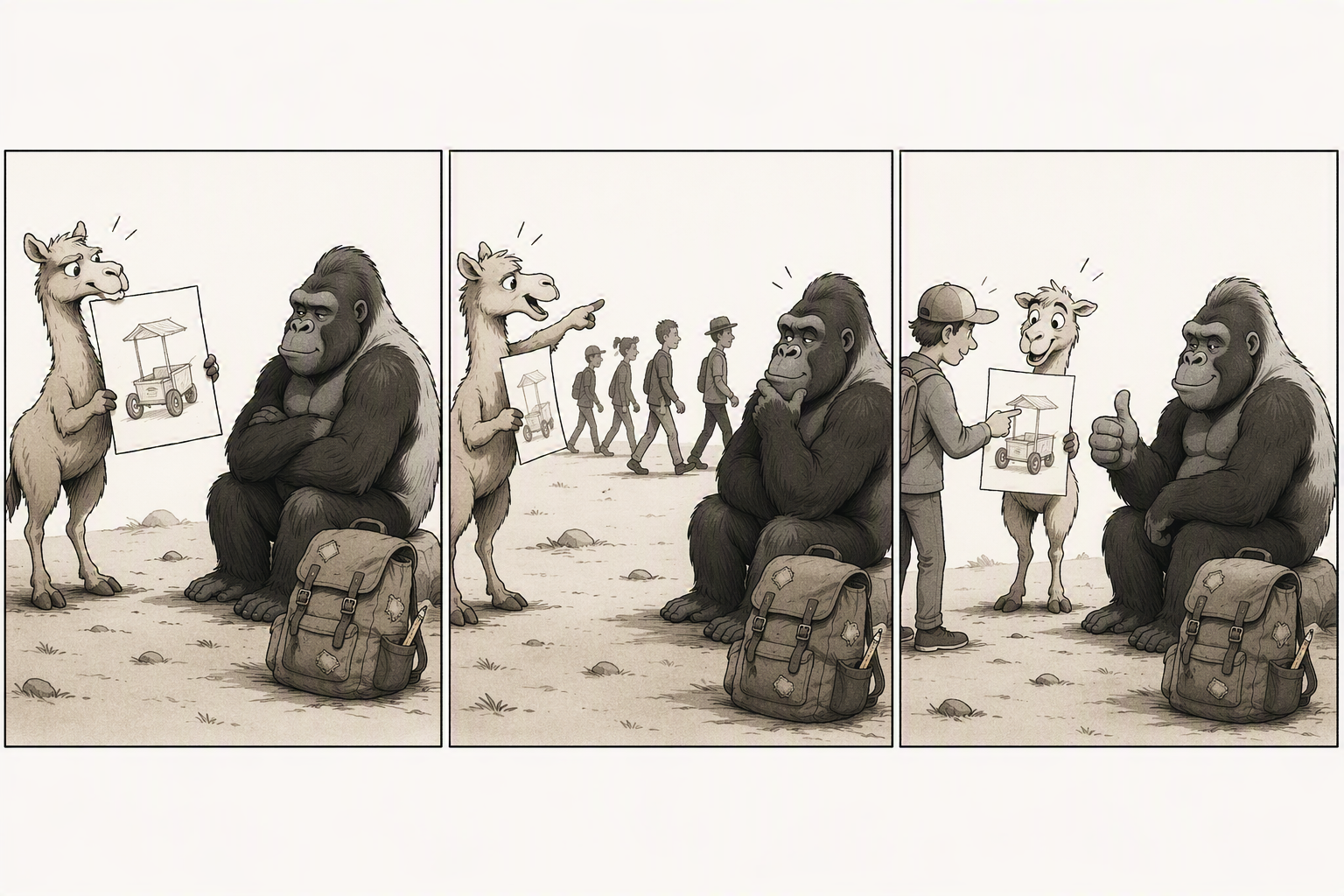
A company can spend years improving a product that no identified buyer has ever committed to. Buyer Proof stops that by asking one question with an uncomfortable answer: has a named buyer given up something scarce, such as budget, signature, time or political capital, to get what you build?
Direct answer
What is buyer Proof?
Buyer Proof is evidence that an identified buyer will commit budget, signature or scarce time to the product, on terms the company can state precisely.
Deeper explanation
What it proves
- That a specific buyer exists and can be named
- That the buyer will act, not only agree
- That the terms of the commitment are known
What it does not prove
- That the buyer represents a segment
- That the value promised was delivered
- That the price is right or durable
- That acquisition can be repeated without founder involvement
Common false signals
- Letters of intent with no cost to the signer
- Free pilots treated as purchase decisions
- Champions without budget authority
- Deals closed only because the founder was personally in the room
- Discounts deep enough that the purchase tests generosity, not need
Founder implications
- You qualify buyers on what they gave up, not what they said.
- You write the commitment terms down before you celebrate them.
- You resist building for a segment before a single buyer has acted.
Investor implications
- You look for the first commercial commitment and its exact terms.
- You discount pipeline that has never converted a scarce resource.
- You separate founder-led sales from a repeatable motion.
Board implications
- You ask for the terms of the last three commitments, not the count.
- You block scaling spend until buyer commitment is documented.
What counts as a scarce resource
- Money that has left a budget line
- A signature that creates an obligation
- Integration or data work by the buyer's own team
- Internal political risk taken by a named person
Where this sits in the book and the OS ebooks
More Scars Than Trophies explains buyer Proof as theory: why the distinction exists and how it changes judgement. The Proof Stack OS ebooks turn it into operating practice, and each OS ebook has its own separate role-specific AI chatbot.
- Proof Stack Daily OS: The founder's operating system for turning proof into daily decisions.
- Proof Stack Investor OS: The angel investor's operating system for evidence-based startup decisions.
Evidence boundaries
What this page does not claim
The limits of the model are stated on the page, not buried in a footnote.
- Buyer Proof concerns the decision to buy. It says nothing about whether the value was received.
- A small number of commitments is evidence for a small number of decisions.
- No specific conversion rate, deal size or timeline is implied by this model.
Audience implications
What changes for each reader
The same evidence standard, read from three different seats.
Founders
- You qualify buyers on what they gave up, not what they said.
- You write the commitment terms down before you celebrate them.
- You resist building for a segment before a single buyer has acted.
Investors
- You look for the first commercial commitment and its exact terms.
- You discount pipeline that has never converted a scarce resource.
- You separate founder-led sales from a repeatable motion.
Boards
- You ask for the terms of the last three commitments, not the count.
- You block scaling spend until buyer commitment is documented.
Author
Petri Lehmuskoski
Petri Lehmuskoski has founded, scaled, repaired and exited companies over more than four decades. He is Founding & General Partner of Gorilla Capital.
Disagree with something here, or want it covered from another angle? Send a short note.
Related
Continue through the model
- Value Proof
Value Proof is evidence that the value delivered is recognised by the buyer in the buyer's own terms, and that it repeats.
- Stage-matched proof
Stage-matched proof is external behaviour strong enough to justify the next irreversible decision at the company's current stage.
- Evidence versus activity
Evidence is a change in external behaviour caused by the company's work; activity is the work itself, and no amount of it substitutes for evidence.
A plain-text version of this evidence layer, generated from the same page content, is available at /concepts.md.
Read the chapter that starts the argument
Chapter 1: Most Founders Do Not Fail Because They Make Bad Decisions. Free to read now, no email required.