Concepts
Problem-Solution Fit and Product-Market Fit
Two terms every founder and investor already uses, and rarely defines the same way twice. Neither is something you can see while you're still building it.
Ask ten founders when they had product-market fit and you will get ten different answers, most of them a feeling rather than a fact. Problem-solution fit and product-market fit are both built the same way: repeated iterations of stronger evidence, each cycle demanding more rigorous proof than the last. Neither label is something you watch for while you're building. Both become visible only in hindsight, once enough of that evidence exists.
The two fits
What each term claims, and what has to be true
Each block states the common usage first, then the evidence the Proof Stack requires before the claim holds.
Problem-solution fit
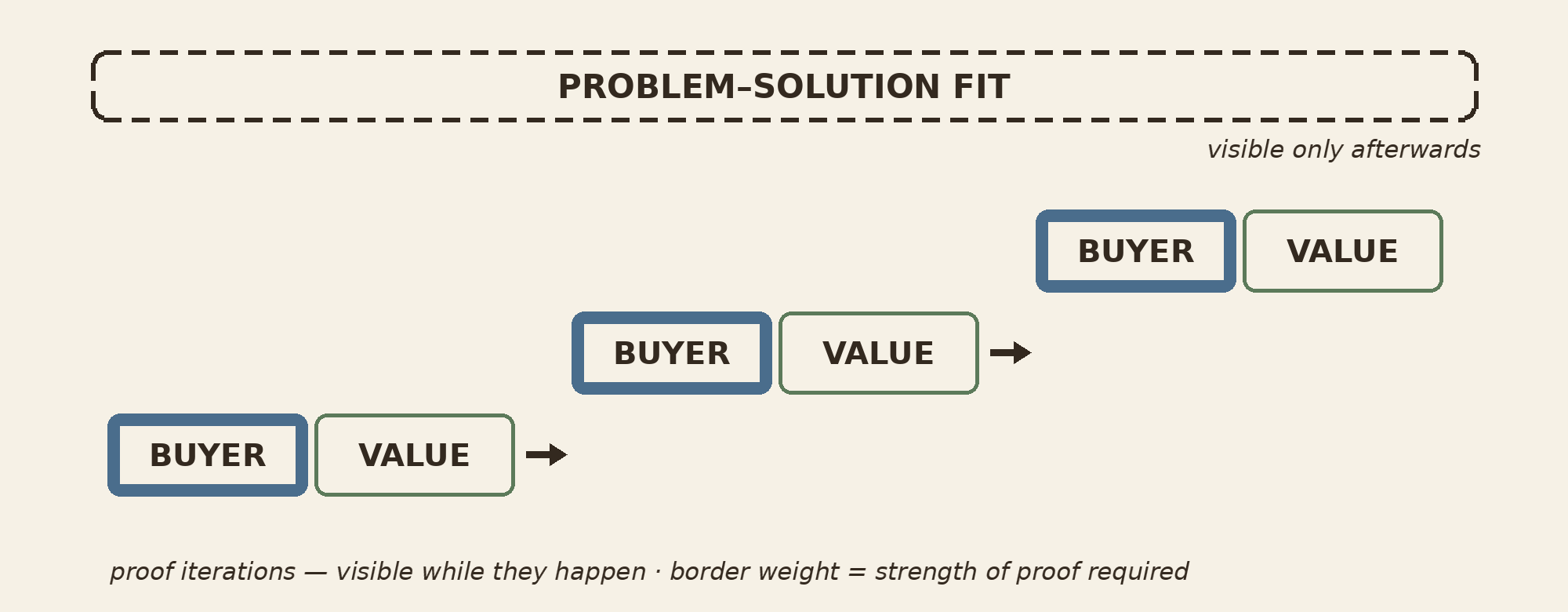
What people usually mean
That a target customer has a real problem, and the proposed solution addresses it, at least on paper or in a handful of encouraging conversations.
What the Proof Stack requires
Not a single conversation but repeated iterations of Buyer Proof and Value Proof, each cycle demanding stronger evidence than the last: a more specific buyer, a clearer commitment, value that shows up more clearly and more often. Problem-solution fit is not a milestone you declare mid-iteration. It becomes visible only after enough of those cycles have accumulated.
Product-market fit
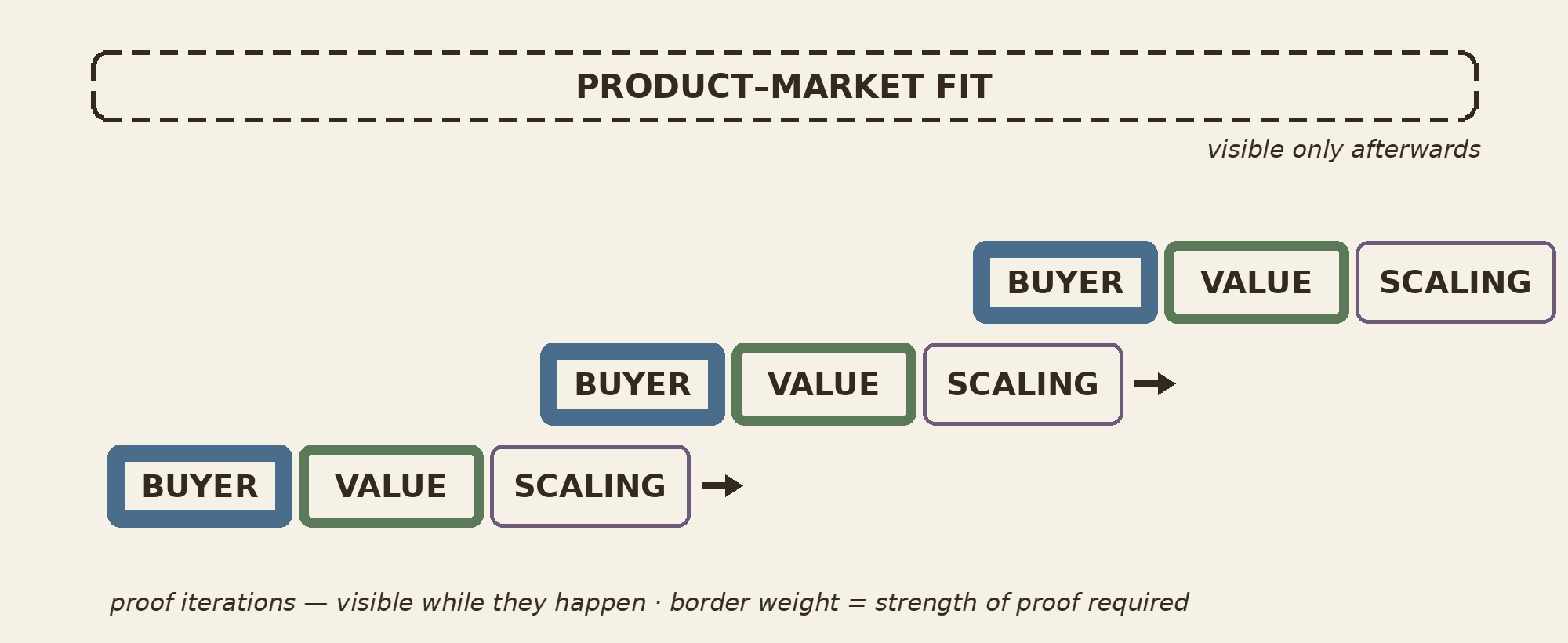
What people usually mean
That enough people or companies want this for it to work as a business, usually signalled by growth, retention or a vague sense of pull.
What the Proof Stack requires
The same iteration, one stage further: Buyer Proof, Value Proof and Scaling Proof compounding together, each cycle stronger than the last. Product-market fit is not a separate milestone reached after problem-solution fit. It is problem-solution fit with Scaling Proof added, and like the first, it is visible only in hindsight, never while you are still mid-iteration.
Neither fit is a milestone you announce while you're chasing it. Each is a specific, compounding claim, and the Proof Stack names exactly what evidence has to exist, and how many times it has to hold up, before the claim is true.
Disagree with something here, or want it covered from another angle? Send a short note.
Read the chapter that starts the argument
Chapter 1: Most Founders Do Not Fail Because They Make Bad Decisions. Free to read now, no email required.