Definition
Recognise the limit your current model cannot be pushed past
Every operating model has a speed beyond which more effort and more money buy disproportionately little.

Companies at their limit usually respond by adding fuel: more spend, more people, more pressure. The cost rises steeply and the result barely moves. Naming the limit changes the question from 'how do we go faster?' to 'what has to change in the model?'.
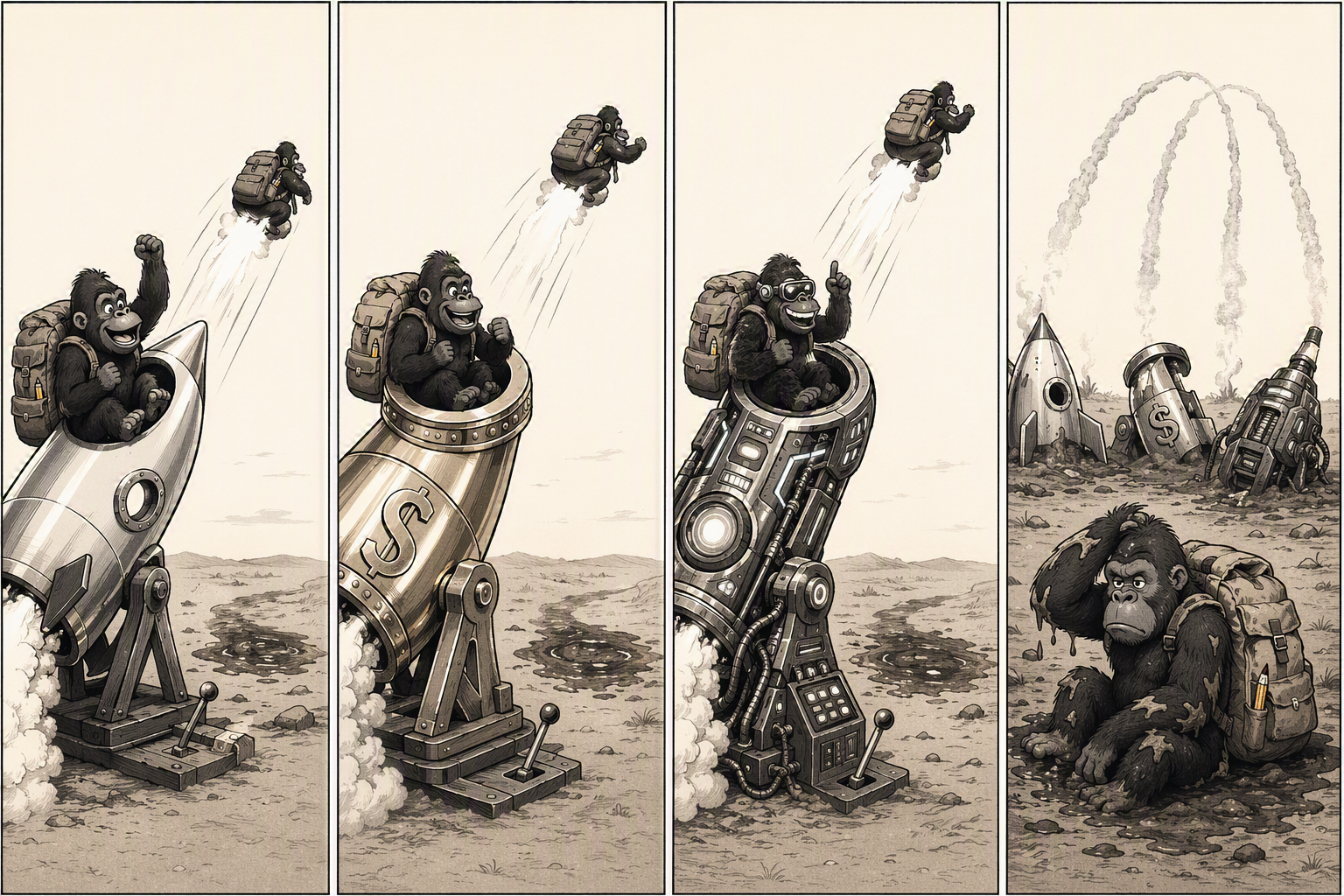
Hull speed is the practical limit of a company's current operating model, beyond which additional spend or effort produces disproportionately small gains.
Direct answer
What is hull speed?
Hull speed is the practical limit of a company's current operating model, beyond which additional spend or effort produces disproportionately small gains.
Deeper explanation
What it proves
- That the constraint is structural rather than a matter of effort
- That the model, not the team, is what needs to change
What it does not prove
- That the company has reached its market limit
- That the model cannot be redesigned
- That growth has ended
Common false signals
- Rising spend with flat output described as a temporary dip
- Adding headcount to a constrained process and expecting linear gain
- Blaming execution for a limit built into the model
- Treating a channel's saturation as the whole company's ceiling
Founder implications
- You look for the constraint before you approve more spend against it.
- You change the model rather than pushing harder on the same one.
Investor implications
- You ask what the next unit of capital is expected to change structurally.
- You test whether a plan assumes performance the current model has never produced.
Board implications
- You ask which constraint a budget increase is designed to remove.
- You resist approving effort against a structural limit.
Where the metaphor comes from
A displacement hull is limited by the wave system it creates. Past a certain speed, extra power mostly makes a bigger wave. Operating models behave similarly: past a point, extra spend mostly makes bigger internal load.
Signs you are already there
- Cost per outcome rises quietly while totals still grow
- Every gain requires an exception, an escalation or a heroic
- Cycle times stretch as volume rises
- New hires take longer to produce than the last cohort
Does this mean lower ambition?
The common reaction to hull speed is that it sounds like an argument for wanting less. It is not.
This does not lower the ambition. It secures the road to it. Matching your pace to what the model can currently hold does not change how large the company can eventually become. It changes whether the company is still standing when it gets the chance to find out.
Where this sits in the book and the OS ebooks
More Scars Than Trophies explains hull speed as theory: why the distinction exists and how it changes judgement. The Proof Stack OS ebooks turn it into operating practice, and each OS ebook has its own separate role-specific AI chatbot.
- Proof Stack Daily OS: The founder's operating system for turning proof into daily decisions.
- Proof Stack Company OS: The company and board operating system for evidence-based governance.
Evidence boundaries
What this page does not claim
The limits of the model are stated on the page, not buried in a footnote.
- Hull speed is a metaphor drawn from displacement hulls; it is an aid to thinking, not a calculation.
- The model gives no formula, threshold or number for identifying the limit.
Audience implications
What changes for each reader
The same evidence standard, read from three different seats.
Founders
- You look for the constraint before you approve more spend against it.
- You change the model rather than pushing harder on the same one.
Investors
- You ask what the next unit of capital is expected to change structurally.
- You test whether a plan assumes performance the current model has never produced.
Boards
- You ask which constraint a budget increase is designed to remove.
- You resist approving effort against a structural limit.
Author
Petri Lehmuskoski
Petri Lehmuskoski has founded, scaled, repaired and exited companies over more than four decades. He is Founding & General Partner of Gorilla Capital.
Disagree with something here, or want it covered from another angle? Send a short note.
Related
Continue through the model
- Scaling Proof
Scaling Proof is evidence that the model continues to hold as volume, complexity and headcount rise, without depending on unrepeatable effort.
- Evidence versus activity
Evidence is a change in external behaviour caused by the company's work; activity is the work itself, and no amount of it substitutes for evidence.
- The Proof Stack
The Proof Stack is an ordered model of the evidence a company must hold before a decision that is difficult to reverse: a Discovery stage followed by four Proof layers (Buyer Proof, Value Proof, Scaling Proof and Exit Proof).
A plain-text version of this evidence layer, generated from the same page content, is available at /concepts.md.
Read the chapter that starts the argument
Chapter 1: Most Founders Do Not Fail Because They Make Bad Decisions. Free to read now, no email required.